Wednesday, April 25, 2012
The Rick Amor Drawing Prize
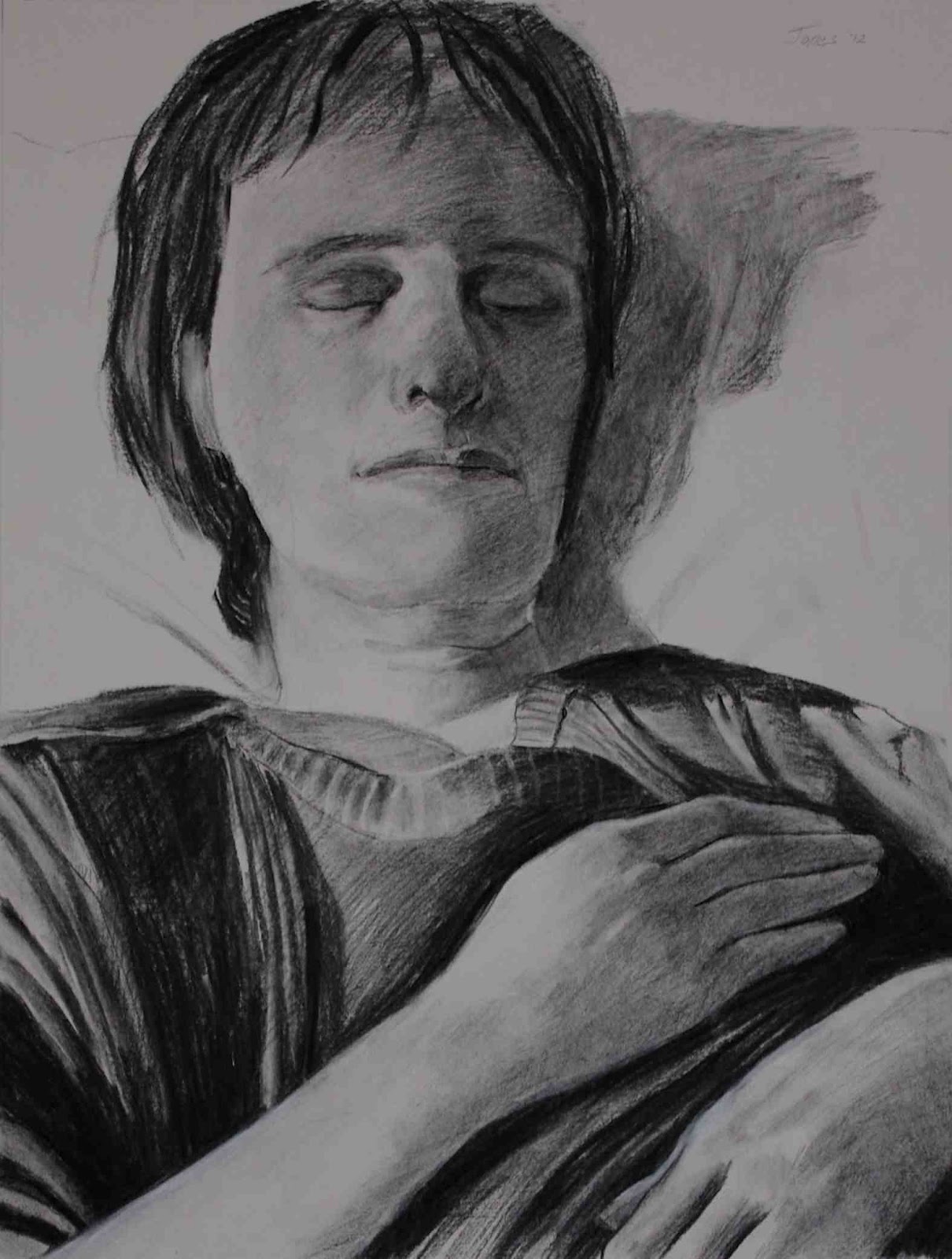
This charcoal drawing, called Sleep, is a finalist in the Rick Amor Drawing Prize which opens at the Ballarat Art Gallery on Friday 27th April, and finishes on 24th June.
I've always been fascinated by the portrayal of a person who is asleep, and it can be a tricky thing to do because there is a fine line between sleep and death.
Wednesday, April 4, 2012
Gustave Caillebotte
I've just bought a book on an artist I've long admired, and one of the great and underrated artists of the Impressionist group, Gustave Caillebotte. He was a wealthy man but he used his money wisely. He formed a fantastic collection of Impressionist paintings, which he left to the French nation and he helped finance and organize the Impressionists' exhibitions over many years. They owed him a lot. He was not strictly an Impressionist painter, but he achieved a wonderful balance between structure and the sunlight and air of Impressionism, and his compositions are amazingly inventive. When you read about the history of Impressionism, he is always an afterthought. Why this artist has been regarded as more of a patron than a significant artist in his own right is mind boggling. But it often gets back to an obvious truth, and that is that many art historians and critics merely recycle what previous writers have said without any critical judgement whatsoever, and they don't bother to look at what is in front of their eyes. Perhaps in general they can't, and sometimes an artist must wait for a time when a real critic with visual insight can set things aright.
For an overview of his work click here http://www.wikipaintings.org/en/gustave-caillebotte
From the top -
Paris Street; rainy weather, 1877, oil on canvas, 212 x 276 cm ( Art Institute of Chicago)
L'Yerres, rain, 1875, oil on canvas, 81 x 59 cm (Indiana University Art Museum)
In a cafe, 1880, oil on canvas, 155 x 115 cm (Musee des Beaux-Arts, Rouen)
Selfportrait, 1892, oil on canvas, 40.5 x 32.5 cm (Musee d'Orsay)
The garden at Petit-Gennevilliers in Winter, 1894, oil on canvas, 73 x 60 cm (Private collection)
The Gennevilliers Plain, seen from the slopes of Argenteuil, 1888, oil on canvas, 65.1 x 81.3 cm (Private collection)
The Man on the Balcony, 1880, oil on canvas, 117 x 90 cm (Private collection)
Floor-Scrapers, 1875, oil on canvas, 100.6 x 145 cm (Musee d'Orsay)
Man at his Bath, 1884, oil on canvas, 170.1 x 125 cm (Josefowitz Collection)
Monday, February 27, 2012
Writing as Drawing?
I am in a drawing exhibition called Contemporary Australian Drawing 2: Drawing as notation, text and discovery to be held at the University of the Arts London from 23 March - 5 April. It is also a collaborative exhibition with RMIT and will be held for the Drawing Out Conference at UAL. Dr. Irene Barberis is the curator for the Australian artists represented in this show.
The artists taking part were asked to respond to the writers Michel Butor and Serge Tisseron's assertions that -
'All Writing is Drawing' and 'The Space of Writing; what does this mean?'
Sometimes I think the art of drawing is often misinterpreted. Drawing and writing each create spaces that allow for the existence of pictures. Words awaken a space that exists only in the mind whereas drawing extends a space onto the paper. Drawing is often thought to be about making marks but it's really about making spaces. Although words make marks, the marks do not create pictorial space on the page and if the words are not understood, then imaginative space will not open within the mind and the words remain just patterns. A blind person can picture what is being read but a drawing will be of no visual value whatsoever.
Text can be an addition to a drawing and reinforce the memory of the artist, but since the different spaces of drawing and writing are achieved in different ways, it means they are not the same thing.
Although my drawing has text, it does not reinforce the drawing visually and doesn't really compensate for the parts that are missing.
It could be argued that one reads a drawing and a text, but that's just wordplay. They are not the same thing and it's like saying a male and a female are the same because they are human beings, or black and white are the same because they are colours. Ciel means sky, but that doesn't mean French is English.
We live in an art world where there is a lot of breaking down of barriers, but we need barriers because they define what we are trying to achieve. If a specific game of sport was now deemed to have no rules, then it would lose its meaning. Anything goes doesn't work, and it's the same for all pursuits.
All writing is drawing? Perhaps no writing is drawing
Image above -
Different Spaces, 2012
Pencil and pastel
35.5 x 25 cm
Sunday, January 22, 2012
Hamburger Banhof
The Hamburger Banhof is a converted railway station and is now one of the major contemporary art exhibition spaces in Berlin. There are many rooms in the gallery and one section extends along a seemingly endless corridor. At the time of my visit, almost every space was filled with installation art and almost all of it was so boring that it felt a shame that such a great exhibition venue was wasted on what looked like an amalgamation of junk. The problem with these installations was the weight of the materials used to illustrate the artists' ideas. There was not enough material transformation to create any magic and the physical presence of the materials used in the works dominated the ideas to such an extent that the whole experience was mind-numbing. Let's hope that this is not the usual exhibition scenario and that artists whose talent matches this fine venue are seen by the public.
Thursday, January 19, 2012
Tricking the Eye
One of the current exhibitions showing at the Art Gallery of Ballarat is titled TRICKING THE EYE photorealist and trompe l'oeil paintings from the Gallery's collection. My two paintings are also from an exhibition I had at the gallery in 2009. The one on the left is a landscape as seen on TV and the other is a white hour glass fastened to a board. Everything is a painting. My partner, Deborah Klein, has one of her paintings in the exhibition also, Vorticist 2.
Tuesday, January 3, 2012
Berlin Wall
Here are some images of the Berlin Wall. The history of the wall is expansive and poignant so it's best to investigate this on other sites. As you know, the wall divided the German people for years until it was torn down in 1989. There is not much left of it in Berlin, only a few kilometres spread here and there throughout the city. The above images have remained for public viewing and are good examples of how people throughout the world left messages which addressed the political and psychological tensions during that time but also messages of hope for an eventual unified nation. There is a section of the wall in another part of Berlin that has been preserved as it was before it was demolished and it can be seen from across the street on a viewing platform. Another remnant called the Wall of Shame is located in a different area of Berlin, so when someone asks for the location of the Berlin Wall, what section of it is the other question that needs to be asked.
Sunday, December 18, 2011
Durer's rhinoceros
I've been looking at Durer's drawing of a rhinoceros for decades and I was always aware that he never saw a rhinoceros, meaning that his drawing was done through descriptions and a quick sketch by another artist. I always thought he exaggerated the facts but when I visited the Berlin Zoo recently there was this Indian rhinoceros which looked like Durer's drawing. There are a few minor mistakes in regard to the anatomy but I never knew there were rhinos that looked like the one in Berlin, so hats off to Durer.
Thursday, December 8, 2011
Kathe Kollwitz Museum Berlin
The Kathe Kollwitz Museum in Berlin is a must see. She was a printmaker, draughtswoman and sculptor and the pain which surrounded her and touched her personally was often the subject matter of her art. Her husband was a doctor so she was acquainted with the harsh conditions of the working classes. She experienced the social devastation of two world wars, lost her son in the 1st World War and a grandson in the 2nd World War. One of the greatest artists of any era, she was as good as Rembrandt in her sense of form and the power of her psychological expression. She produced over fifty amazing self portraits but words aren't enough. See her work at the Kathe Kollwitz Museum website http://kaethe-kollwitz.de/werkschauz-en.htm
Wednesday, December 7, 2011
Bode Museum
The Bode Museum in Berlin focuses on sculpture. Sculptures were often coloured but when we see them in museums they are generally white. Time gradually erodes the pigments and leaves us with a ghost image of its former self. The Bode Museum has stunning examples of how sculptures were generally viewed at the time they were made. The bottom example by Pedro Roldan is amazing especially in the way he creates tears running down the face. Its title is Maria die Schmerzensreiche (Our Lady of Sorrows) 1670-76. The carving of all of these works is very crisp, a quality that only strong concentration can give a work of art.
Monday, November 28, 2011
Berlin
Berlin was a a great experience and very different to London. It wasn't as crowded and because of that it felt more relaxed. Of course there were many outstanding museums around the city. The Pergamon, so named because it has the 2nd Century Pergamon Altar as one of its main features (top image) was an inspiration. It's best to google it to read about its history. Obviously only fragments survive, and some of the reasons for this is that when the German archeologist, Carl Humann, began excavations in 1878, the frieze was systematically being torn down to reuse the stones for other buildings and the marble figures were being burnt to get lime! Imagine that! There is an amazing drawing under the frieze where the artist, Yadegar Asisi, imagined what the completed sculpture might look like. Here is a sculpture fragment and the drawing of it as an example (3rd and 4th from top). The entire drawing has been photographed on an angle as it was the only way I could fit it in.
I was also taken with the encaustic portraits from ancient Greece, as shown above. These were funeral images but the artists have conveyed the life of their sitters in these images, almost as a contradiction that the person has passed on. You could speak to her.
Friday, November 25, 2011
Vermeer?
During my visit to Cambridge University, I saw an exhibition titled Vermeer's Women, Secrets and Silence. I expected to see quite a few of Vermeer's works but out of a total of twenty eight paintings, only three and a half were by Vermeer. It was another example of a touring exhibition being promoted to be something that it isn't. Sure, there were many outstanding pictures by Vermeer's contemporaries, so why not include their input into the exhibition by reflecting this in the title? Three and a half Vermeer's? The half is the Vermeer pictured above. It was recently sold for $A30 million dollars. Technical analysis says that it was painted on a piece of canvas identical to the canvas on which Vermeer painted The Lacemaker, but what a difference in quality!! When I first saw it I was a little shocked that this is supposed to be a Vermeer. The face seems to have been retouched by another hand or cleaning has removed some of the paint Vermeer put on himself. There is a lack of resolve in the face. The yellow cloak seems heavy, the light contrast is severe for a typical Vermeer light and the proportions lack the elegance of his mind. When Vermeer died he left many debts so how could his family repay them? It would be unlikely that an incomplete painting could be sold so might it be that this is a picture Vermeer didn't complete at his death and someone else has finished it? It looks like it to me. What do you think?
Wednesday, November 23, 2011
A visit to England
I've just returned from a trip to England and Berlin with my partner, Deborah Klein, and what a fantastic time we had. It's always a thrill and a privilege to visit the great museums of England and Europe. Whenever we visit London, we stay with Barbara and Sue in Hampstead, about a five minute walk to the heath, and sometimes with Bev and Roger.
Since a visit to London means seeing many things, I thought I would highlight just a few of them to give you a taste of what awaits those who are interested in art.
One of my favourite Turner paintings (top) was inspired by the light at Petworth Park where he often visited. This hangs in Tate Britain in the section devoted to the work of Turner. It's an interesting part of the gallery because there are a few unfinished abstract paintings there and they are hypnotic to see. It's tempting to say that he practiced Abstract Expressionism before 20th Century American artists did.
John Constable is one of my favourite artists. I've included one of his cloud studies (second from top) as an example of some of his work I saw. To catch fresh air and natural light in paint is a great achievement and it's one quality I admire in a painting. Whenever I visit London I always go to Constable's grave (above) in the churchyard of St. John's in Hampstead. Across the road, there is also the grave of Anton Wallbrook, one of the great Hollywood actors who starred in films like The Red Shoes, Gaslight and The Queen of Spades.
There was an interesting exhibition of the work of Gerhard Richter at Tate Modern. I've never been a fan of his until I saw the work in the flesh. Whenever his paintings are reproduced in books, the sense of paint is missing, but this exhibition dispelled all my negative opinions about him. There was a room of all grey abstract pictures, very thickly painted and yet elegant in there realization. I was also impressed with the thoughts behind all the works and the variety of his oeuvre.
Another exhibition I saw was on John Martin, an artist who painted pictures of biblical apocalypses, invading armies and utopian landscapes - a Cecil B. Demille of the early to mid 19th Century. Amazing technique but I don't think I could live with many of his works, the theatrics can be a bit much. He travelled the world with some of his pictures, including Australia, exhibited them in special lighting conditions and charged an admittance fee. Tate Britain set some of these up, just like Martin would have, in a dark room and highlighted sections of them, all very dramatic. But the curators made a big mistake when they decided to overlap the paintings with moving light projections of their own design. This is saying that Martin failed to achieve the drama he aimed for in his work and therefore needed the enhancement of technology to make it better - what complete nonsense and how disrespectful to the artist. It just goes to show how technology has hypnotized the brains of so many people.
Continuing on with the critical line, I also thought that the light in the museums was too dull. One of the most important characteristics of paintings is their inner light, and this is never allowed out if they hang in a twilight. I understand this from a conservation point of view, but lighting conditions vary a great deal in museums all over the world, so if some can create a good exhibition light then why not all museums.
One of the highlights of my England trip was a visit to Cambridge University to see the fan-vaulted ceiling of King's College Chapel. Two pictures above will give you an idea of its majesty. It would have to be one of the greatest things ever made by human hands, an awesome sight to behold. For me, that's what art should be - to look at something in wonder and experience a magic that is beyond explanation.
London has so many great and inspiring cultural institutions to explore and you really need many visits or long stays to become familiar with their treasures. The Courtauld Institute of Art (bottom picture with me looking at Manet's Bar at the Folies Begere), the Wallace Collection, Kenwood House, the V&A Museum, The V&A Museum for Childhood, The Imperial War Museum, The British Library, The Fitzwilliam Museum in Cambridge University and many more. Of course that's not all. London theatre, cocktails at the Savoy, snacks at The Crypt, a visit to Gordon's Wine Bar, a trip to the country and catching up with friends, all this makes for a great overseas trip.
Friday, September 23, 2011
Saatchi at the Art Gallery of South Australia
Recently I visited the Art Gallery of South Australia to see the Saatchi collection. I didn't expect to see much work that was inspiring but I was surprised. The paintings were a little disappointing, even incompetent, except for a few works, but some of the installations were engaging. Even if you see a handful of works that are good it makes it worth while. I haven't heard of most of these names because they are the new wave of artists Saatchi is collecting. Here are some examples of what was in the gallery.
From top -
Jonathan Wateridge
Jungle Scene With Plane, 2007, oil on canvas
Ged Quinn
The Fall, 2006, oil on linen
Craig Little and Blake Whitehead
It Happened in the Corner, 2007, plaster, wax, foam, hair, clothes
Des Hughes
Endless Endless, 2010, polyester resin, iron powder, fibreglass, plastic wood.
Artist talks at Maroondah Art Gallery
Monday, July 25, 2011
Lucian Freud
One of the great artists passed on recently, an artist who has inspired me for decades - Lucian Freud. In the eighties I was introduced to his work by another fan and friend of mine, Bill Reid. In 1992, Bill and I travelled to the Art Gallery of New South Wales to view a survey exhibition of his work and to this day, we still agree it was one of the most awe inspiring and memorable exhibitions we have experienced. He was not as well known in Australia at that time, demonstrated by the fact that Bill and I had the entire exhibition almost to ourselves. It was fantastic that we could linger in front of the work without interruption. I love one of his sayings - 'I want to paint myself to death' and he did. Like Michelangelo, he was an example that you can get better with age. Although his range was narrow, his work never seemed repetitious and was a wonderful balance of observation and invention. What a body of work he left to future generations.
Pictured above is his Reflection (Self-Portrait) 1985, oil on canvas, 56.2 x 51.2 cm
Subscribe to:
Posts (Atom)


