Friday, May 30, 2014
Hockney at Dulwich Picture Gallery
One of the highlights of our UK trip was a visit to the Dulwich Picture Gallery where there was an exhibition of David Hockney's prints, celebrating sixty years of his printmaking practice. One of the most experimental and adventurous artists of our time, this exhibition was a treat, mainly because it's always inspiring to see work that has a strong drawing component. Etchings, lithographs, combinations of mediums and works composed and printed through a computer showed just how adventurous he is. The human figure was prominent throughout but there was also a series based on different weather conditions, confirming that Hockney could tackle various subject matter. Some of the prints were a little garish in colour, and his more subdued images appealed to me, but there were so many gems in this show you wished everyone could see them.
The Dulwich Picture Gallery has a great collection, more quality than quantity. Check it out HERE
More of David Hockney's work can be viewed HERE also.
Deborah Klein took the photographs of our day at Dulwich.
Friday, May 23, 2014
A Recent Time in the UK
Lee Miller and Roland Penrose
Deborah Klein and I recently returned from a trip to the UK. One of the most inspiring days spent there was a trip to Farley Farm House, courtesy of Barbara Britton and Sue Verney. This was the house and property that was home to Surrealist artist Roland Penrose and his wife, photographer, Lee Miller. Many famous artists visited the property over the years, notably, Picasso, Max Ernst and Man Ray, to name a few.
A guided tour is the only way you can see inside the house, and what a fabulous house it is. Pretty much how it was when they lived there, the walls are covered with art, mainly by Roland, but artworks from the many artists who stayed for a time can also be seen throughout. The fire place is a remarkable art work too, decorated by Roland with great colours and nooks and crannies which provide spaces for ceramic pots and figures.
The grounds, as I think you would agree from the photos below, look magnificent under the sunny sky. The whole place had such a good feeling to it, but an extra treat was talking to Antony Penrose, son of Roland and Lee. He lives down the road to the property but his presence is of course always at Farley Farm House. He saw a great deal of Picasso when he was a child and he told us an amusing story. Resuming school after the holidays there was a show and tell. He mentioned that the family went to Cannes and when asked what he did there he told the class he went to see Picasso! The teacher was understandably gob smacked but as Antony told us, he presumed everyone did!
Since no photography is allowed in the house, it might be a good idea to click on the link to find out more information about it. HERE
You might also like to check the websites of Lee Miller and Roland Penrose
View of Farley Farm House
Inspecting the garden
A sculpture in the grounds
Deborah Klein at Farley Farm
Barbara Britton, me and Sue Verney standing alongside one of Antony Penrose's sculptures
Wednesday, May 7, 2014
Print and Drawing Acquisitive Awards 2014
Deborah Klein Cutting Lino, 2013, dry pastel, 31 x 41 cm
My partner, Deborah Klein, made a wonderful print called Corporeal-Ethereal, and my drawing is of her in the process of cutting the lino that eventuated in the linocut print.
We have all heard it said that the eyes are a window to the soul, but I think hands reflect the soul too. Hands are the soul in action which is clearly visible in master musicians, dancers, horsemen, and snooker players, just to take some examples. Within the hands is not only beauty but thought.
My drawing will be in the Print & Drawing Acquisitive Awards 2014 at the Swan Hill Regional Art Gallery from May 17 until July 13. Look them up at www.swanhill.vic.gov.au/gallery
Here is Deborah's finished print.
Wednesday, March 26, 2014
Christening Dress
I've always loved still-life as a subject matter, and white is also a favourite colour of mine. Lacework is a challenge to paint, and this christening dress caught my eye as a perfect opportunity to explore all these aspects in a single painting. Here are some images of the work in progress.
Christening Dress, 2013, oil on canvas, 91.25 x 50.25 cm
Wednesday, March 12, 2014
Charles Nodrum Gallery 30th Anniversary
With Lisa Barmby at the opening. Also from left, in profile, Lewis Miller,
Tom Alberts in blue shirt and Angela Cavalieri
Until March the 29th, Charles Nodrum Gallery has a group exhibition featuring 30 of its artists. The exhibition celebrates the gallery's 30th birthday, a remarkable achievement. Last Saturday saw Charles host an opening with food and wine, and along with some wonderful conversation, it was a nice way to mark the occassion. By the way, 30 artists and 30 years was just a coincidence!
Friday, March 7, 2014
Johnny Ghost
Johnny ghost has just been released on DVD. The subheading for the film is "The past is inside you every day of your life', and that's a good way to describe the story - a film about being haunted by one's memories.
I just had to get the autographs of the main people involved in the making of the film, as you can see on the top image - Donna McRae is the writer, director and producer. Michael Vale the production designer, Anni Finsterer the main actor, the director of photography is Laszlo Baranyai and Dave Graney and Clare Moore composed the music. Deborah Klein and I had a small roll - as a couple having an argument in the background.
I love black and white films, they're both real and dream-like at the same time. Donna gave a screening at ACMI recently and during the Q&A Michael pointed out that the black and white was shot in colour first and then altered afterwards. There were many insights and techniques discussed and I'm always amazed at what it takes to make a film. It would have to be one of the most complex art forms there is.
Wednesday, February 19, 2014
Duchamp and His Legacy
In 2004, a panel of art experts voted Marcel Duchamp
the most influential artist of the 20th Century. But was Duchamp a
genius, or a person who used objects and words to illustrate certain ideas?
“Isn’t that what an artist is?” you might say. But by that definition anyone is
an artist, because we all use objects and words to express ourselves.
Why would Duchamp want to question the value of
retinal art? By retinal art he meant that which pleases the eye, yet we have
centuries of great art that pleases the eye but with intellectual and emotional
depth as well, something Duchamp chose to ignore. Duchamp’s early paintings,
competent though they are, and the fact that he abandoned painting altogether,
suggests that perhaps he realized he would not be the artist he desired to be.
Apart from Nude Descending a Staircase, No.2, 1912,
his works touched on Impressionism and Modernism but without much exploration
or distinction. One could argue that he abandoned painting because he was
destined to change the course of art. But in what way?
Duchamp said that art, etymologically, means to do,
that art means activity of any kind, and that it is our society that creates
purely artificial distinctions of being an artist. By this definition, there is
no difference between creating Rembrandt’s The Nightwatch and sweeping the floor. But such distinctions are not artificially
created by society, they are a fact. Labour and skill will not create a work of
art like The Nightwatch, so what else did Rembrandt put
into his labour that elevates it to such a high achievement?
Duchamp proposed the idea that when an object is
exhibited out of context a new thought is created for that object, which is
art. It is the thought rather than the object that matters. Or as Duchamp put
it when he exhibited a urinal:
Whether Mr Mutt made the fountain
with his own hands or not has no importance. He CHOSE it. He took an article of
life, placed it so that its useful significance disappeared under the new title
and point of view - created a new thought for that object.
Fountain, 1917
Of course one might look at an object differently when
it is presented in an unfamiliar context, but does that make it art? If a Monet
painting was exhibited in another context it will not alter or negate the
thoughts that are already painted because the art is within its material and is
independent of where that material is exhibited.
Duchamp also proposed that the
viewer is just as important as the artist when he said:
The creative act is not
performed by the artist alone; the spectator brings the work in contact with
the external world by deciphering and interpreting its inner qualifications and
thus adds his contribution to the creative act.
But a response to a work of
art is not the creative act. The art has to be created before it can be responded to. Art has
its own presence in the world whether anyone sees it or not. Like trees in a
forest, even though we are not looking at them, they are still there. Art is
independent of the viewer, that’s why authorship is important, because it’s the
artist who brings it into contact with the external world. The viewer can
extend the art created by the artist into the world, like a ripple in a lake,
but the ripple is different to the stone that caused it.
Duchamp’s viewpoint was a kind of anti-art, opposing
everything that defined the art of the past. He said that he was interested in
ideas, not merely visual products. The word products suggests commodities, but art is never just a visual product, even
though money is associated with it. He opposed aesthetics as a quality that
also attracts sales, but he mistook soul qualities for marketing values. What
time has taught us is that the market is about desirability, and that anything
can be bought and sold if it is desired -
and Duchamp wasn’t spared either. Beginning in 1950, Duchamp started
authorizing curators to purchase urinals in his name, like a printmaker
editioning proofs. One sold for $1.8 million in 1999.
Duchamp also wanted to ‘de-diefy the artist’. His
painting, L.H.O.O.Q. 1919, is his visual joke
about, as he saw it, the overblown importance of the artist. But when his work Nude
Descending a Staircase, No.2 was exhibited at the Armory Show in 1913 in New York, Duchamp became the celebrity
artist himself. In fairness to Duchamp, no-one can be a celebrity or make a lot
of money unless those around them support and promote them, but it is ironic
that Duchamp became the very things he said he opposed.
Nude Descending a
Staircase No 2, 1912, oil on canvas, 147 x 89.2 cm
Art created from traditional mediums is often referred
to as the art object, but that’s a misconception. Art is thoughts within a
material support, which makes it more than its material, identifies it as
something more than an object. This misconception has influenced conceptual
artists when they claim that the idea is more important than the object. But it
doesn’t ring true where we see in so much contemporary art a reliance on huge amounts of materials to support an idea. Sometimes
rooms full of it. So much physicality can overwhelm a concept and give
prominence to objects rather than the importance of the mind.
Much of the contemporary art we see in Biennales and
Triennales is not only Duchamp’s legacy, but is today’s mainstream art,
otherwise known as New Media art - that is, any medium
that avoids the traditions of painting, drawing and printmaking. New Media sees
itself as the avant-garde but calls itself cutting edge. Historically, the avant-garde has always opposed fashionable mainstream
art practice, therefore New Media has either inverted history or sees itself as
the beginning of a new one. We should also reflect on the fact that Duchamp
exhibited his urinal almost a century ago, so his legacy is already a tradition
rather than contemporary cutting edge.
Perhaps no other art form has been so undermined by
the seduction of words as visual fine art. Sol Le Witt proposed that anyone can
draw simply by following his instructions. But his thinking limits those who do
follow his instructions to perpetual pattern making. There is a big difference
between drawing like Degas and making a pattern. Le Witt said that art is like
learning the notes in music and if you can do that then you can make music. But
sometimes we hear it said that someone can play the notes and yet they are not
that musical – a technician rather than a musician. Drawing, like music, comes
from the gods rather than from any text.
Of course, there are wonderful artists who do not use
traditional media, like Bill Viola, Hossein Valamanesh and Louise Bourgeois for
example, artists who have made magical things. But so much that is celebrated
today is a long way from these artists. Before Duchamp, it would be
unimaginable to see a person can their own excrement and sell it as art. Since
Duchamp, we have seen just that, as Piero Manzoni did in 1961.
Duchamp’s legacy has fostered some amazing artists but
the problem is that most conceptual art is on the same level as reality
television, where we see so much banality celebrated. The celebration of it is
the problem. Camille Pissarro once said that he wanted to make the ordinary
into something extraordinary, but today it’s like keeping the ordinary as it
is. Grayson Perry made a telling statement when he said:
I am increasingly being dissatisfied with the
context of the contemporary art space as an arena where I want to put my work.
Things are given a spurious significance by being in the gallery now. It used
to be that you built a gallery to put significant objects in, now you put
insignificant objects in the gallery in order to give them significance.
Duchamp’s viewpoint was primarily a response to the
times in which he lived, but they have passed. Perhaps his legacy needs to be
looked at with more discernment.
Shane Jones
Shane Jones
Saturday, February 8, 2014
Sue Verney and the Racecourse
Recently I received an email from a great friend of mine in London, Sue Verney. Sue is a musician who plays violin, a poet and short story writer. I felt honoured to receive Sue's poem about one of my racetrack paintings, and I'm just as thrilled to share it with you.
RACECOURSE
After
the silent gas cloud came
the
empty racecourse looked the same.
But
if not galloped upon or mown
how
soon will it be overgrown?
Or
without refreshment slake to dust
with
shades of bone and sunburnt rust.
Saturday, January 4, 2014
Contemplating Pictures on Walls
But I sometimes read in art reviews and articles, and even hear from curators, how wonderful it
is that we can now engage with art through various physical activities like
pressing buttons, turning on lights or throwing things around etc, instead of
looking at static pictures on a wall. But how shallow and even dumb have people become when
they think like this? Great
pictures are never static because they have the current of the mind pulsing
through them. Looking at pictures on a wall is like reading a book. You don’t need props like buttons and bells to interact with the words because one’s interaction is
done imaginatively, and pictures on walls need the same approach.
Fine art isn't a sport or a carnival sideshow and should remain that way.
The great paintings, drawings and prints of the past are relevant today because they express something eternal within them. Pressing buttons, ringing bells or jumping up and down doesn't connect you with that condition.
Shane Jones
David Hockney - Looking at Pictures on a Screen, 1977, oil on canvas, 188 x 188 cm
The great paintings, drawings and prints of the past are relevant today because they express something eternal within them. Pressing buttons, ringing bells or jumping up and down doesn't connect you with that condition.
Shane Jones
David Hockney - Looking at Pictures on a Screen, 1977, oil on canvas, 188 x 188 cm
Thursday, November 14, 2013
The Sketchbook at the VCA
On a recent post I mentioned The Sketchbook Project, a project created by the Brooklyn Art Library, New York, where anyone can sign up, create a sketchbook and have it tour throughout the USA. Amazingly, the Brooklyn Art Library decided to visit Australia and show off the thousands of sketchbooks from Australian and New Zealand artists. The Victorian College of the Arts hosted the occasion and it was interesting to see just how the public is able to access the books.
My partner Deborah Klein and I looking over each other's sketchbooks.
A page from Deborah's book, on the left, and a page from mine.
Registering for a library card. This card can now be used anywhere in the world where The Sketchbook Project is touring.
The two young American Librarians, who were so friendly and helpful, but were handicapped by a computer system that habitually stopped working.
Deborah outside the Victorian College of the Arts building with The Sketchbook Project sign at the door.
Wednesday, November 13, 2013
The Art Vault 5th Anniversary
Over the Melbourne Cup weekend (2nd and 3rd November) The Art Vault celebrated its 5th anniversary, and what an event it was! Julie and Kevin Chambers, who own and manage The Art Vault, hosted an opening and dinner for well over one hundred people, and the next morning the celebrations continued with brunch on the lawn of their home. They are an incredibly generous couple and have done so much for artists and Australian culture in a relatively short time.
An exhibition of the work of artists who have had a residency at the Art Vault took up the two gallery spaces. Sasha Grishin opened the exhibition and a big weekend of talking, eating and drinking followed. Some of the artists stayed on the Chambers' houseboat and on another one they hired for the duration.
The photos below give some indication of the weekend.
Julie and Kevin have 5 copies of this large hardback book they had made to mark the occasion. Some of the images show the transformation of the building into the Art Vault complex. Other images feature the artists and their work. This double page shows me, and Deborah Klein on the right.
Two limousines collected the artists from the houseboat and delivered them to the Art Vault door.
These young women were delightful hosts
Sasha Grishin giving the opening speech
Julie Chambers thanking all the artists, her staff and especially her husband Kevin, seated in white shirt.
There were 3 usherettes who served at the opening and they dressed in imaginative costumes, reflecting the joy and theatre of the night
At brunch the next day. From left - Andrew Svrta, Shane Jones, Peter Lancaster, Wendy, and Stephanie Bolt
Kevin, eX de Medici, Julie and Ros Atkins
The Art Vault was once a bank, and the old vault doors still remain. There was a life-size reproduction of the door and everyone at brunch signed it. Here is Deborah Klein adding her signature.
Deborah and Peter Lancaster
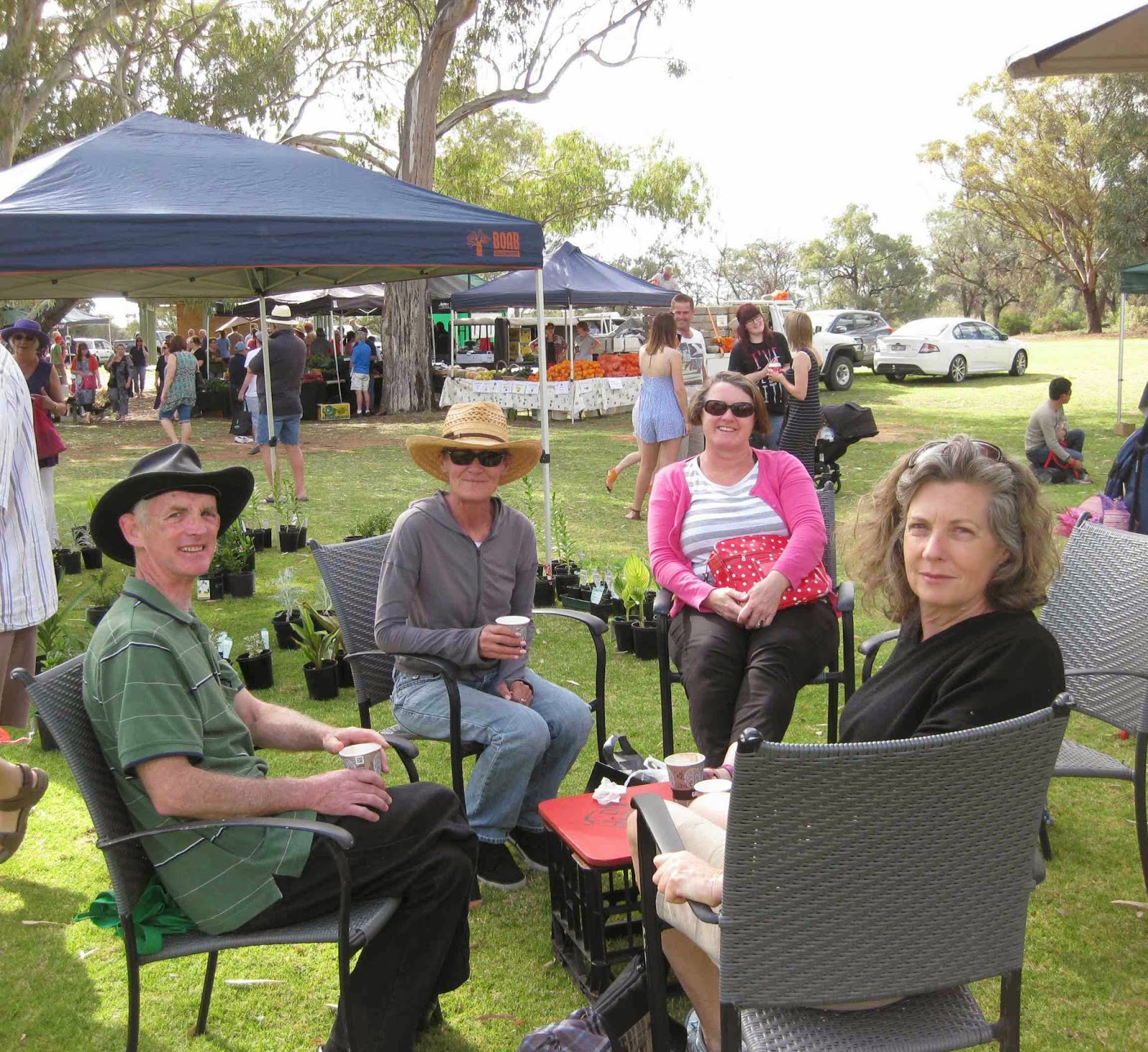
At the farmers market by the Murray. Shane, eX, Stephanie and Ros
On the houseboat. Clockwise from me - Sasha Grishin, eX, Stephanie, Ros, Martin King and Rod Gray.
It does look like a postcard, but it really is this good whenever we stay on the houseboat.
Anne Spudvilas lives on the Murray River, and some of us met her for the first time over the weekend. We visited Anne's house and studio and had a really nice afternoon. Deborah, Shane, Susan Baran, Anne Spudvilas and Martin
Subscribe to:
Posts (Atom)